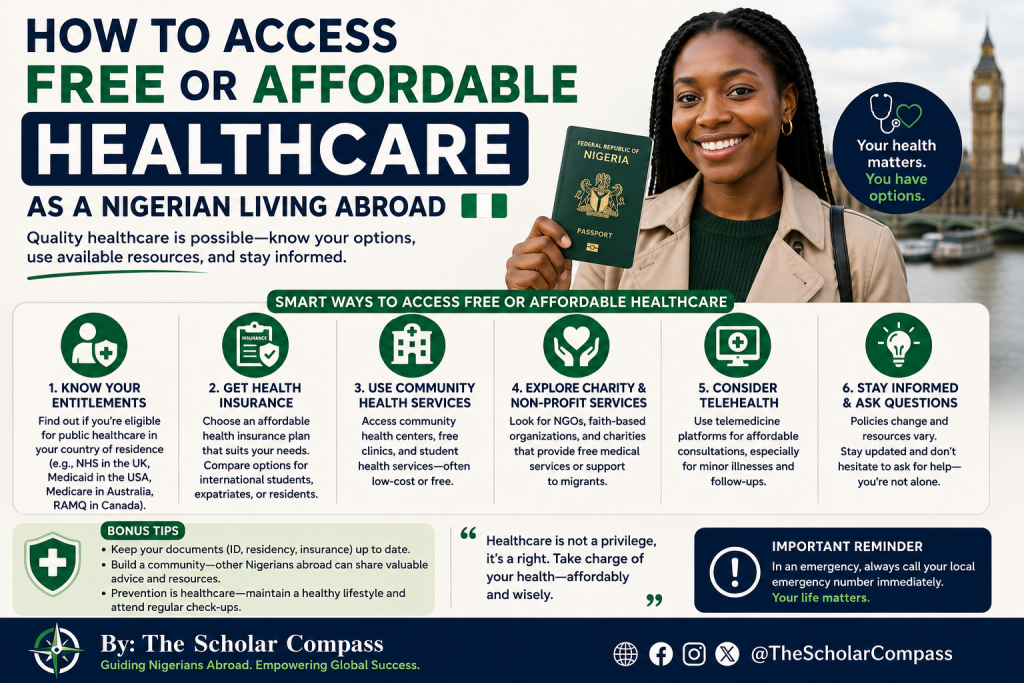
So, you’re a Nigerian living abroad and trying to figure out healthcare? It can definitely feel like a maze, right? Whether you’re a student, a professional, seeking refuge, or even undocumented, knowing how to get free or affordable medical care is super important for you and your family. This guide is here to break it all down for you, country by country, by program type, and even by your personal situation, so you can make smart choices without emptying your wallet.
Why Healthcare is a Big Deal for Nigerians Abroad
Nigeria has one of the biggest diasporas in the world, with millions of people spread across the UK, US, Canada, Ireland, Germany, Australia, and beyond. Even though Nigerians are contributing a lot to these host economies, many, especially newcomers, students, and those without proper documentation, find it tough to get medical care. It’s usually because of the high costs, not knowing where to go, or worries about their immigration status.
Healthcare costs can be shocking. In the US, a single ER visit without insurance can cost thousands of dollars. In the UK, seeing a regular doctor privately, without being part of the NHS, can set you back £60 to £150. But don’t lose hope! Most countries have some pretty great free or subsidized healthcare options out there – you just have to know where to look.
Getting Free Healthcare in the UK
The UK’s National Health Service (NHS) is one of the most generous public healthcare systems globally, and tons of Nigerians living there can use it for free or at a low cost.
Who Gets Free NHS Care?
Students: If you’re on a student visa for more than 6 months, you’ll pay an Immigration Health Surcharge (IHS) when you apply for your visa. Once that’s paid, you get full access to NHS services without extra charges during your stay.
Workers: Those on skilled worker or health and care visas also pay the IHS and are covered by the NHS.
Permanent Residents & Citizens: Nigerians who are permanent residents or British citizens get the same full NHS access as everyone else.
Asylum Seekers & Refugees: You’re entitled to free NHS treatment, including registering with a GP, mental health services, and maternity care.
Undocumented Migrants: Even without a visa or NHS registration, you can get free emergency treatment and certain specific services like care for infectious diseases, family planning, and antenatal care.
How to Sign Up with an NHS GP
Registering with a local GP (General Practitioner) is your key to unlocking free NHS healthcare. You don’t need to show proof of immigration status to register. Just pop into your nearest NHS GP surgery, ask to register as a new patient, and fill out a quick form. Once you’re in, you can book appointments, get referrals to specialists, and pick up prescriptions at the standard NHS charge (currently around £9.90 per item, or free if you qualify for exemptions).
Pro Tip:
Check out the NHS website (nhs.uk) to find GP practices that are accepting new patients in your area.
Getting Affordable Healthcare in the US
The US healthcare system is known for being pricey, but there are several programs designed to help low-income immigrants and Nigerian residents get care without breaking the bank.
Medicaid and CHIP:
Medicaid is a government program for low-income individuals. Eligibility differs by state, but lawful permanent residents (Green Card holders) who’ve had their status for at least five years are usually eligible. Some states, like California and New York, even offer Medicaid for emergency and pregnancy-related care to immigrants regardless of their documentation status. CHIP (Children’s Health Insurance Programme) provides low-cost or free coverage for children whose families earn too much for Medicaid but can’t afford private insurance.
Community Health Centres like Federally Qualified Health Centres:
These are government-funded clinics that offer care on a sliding fee scale, meaning your costs depend on your income. Many charge as little as $20–$40 per visit. They serve everyone, no matter their immigration status, and often have multi-lingual staff. You can find one near you by visiting findahealthcenter.hrsa.gov.
Affordable Care Act (ACA) Marketplace Plans:
If you’re legally in the US (on work visas, student visas, or as a Green Card holder), you can buy health insurance through the ACA Marketplace. Depending on your income, you might get subsidized rates. Nigerians with moderate incomes often qualify for significant premium tax credits, making plans much more affordable.
Getting Healthcare in Canada
Canada has a provincial public healthcare system that covers most necessary medical services for free at the point of service for residents. If you’re a Nigerian immigrant or permanent resident in Canada, here’s what you need to know:
Provincial Health Insurance:
Each province has its own health insurance plan (like OHIP in Ontario or MSP in British Columbia). Once you arrive as a permanent resident or worker, you’ll need to apply for this coverage. There’s usually a waiting period of up to three months before it kicks in, so it’s crucial to get temporary private insurance in the meantime. Students on study permits and workers on various permits are generally eligible after meeting residency requirements.
Free Clinics and Community Health Centres:
Canada has a great network of community health centres that offer free or low-cost services to those without insurance, newcomers, and people waiting for provincial coverage. They often provide primary care, mental health support, dental referrals, and social services.
Refugees and Asylum Seekers:
They are covered under the Interim Federal Health Programme (IFHP), which provides basic medical, dental, and vision coverage until their provincial health insurance becomes active.
Getting Healthcare Across Europe
Most European countries offer universal or almost-universal healthcare to their residents, including Nigerian immigrants.
Ireland: Nigerians living legally in Ireland including students, workers, and permit holders, can access public healthcare through the HSE (Health Service Executive). If you have a low income, you might qualify for a medical card, which covers GP visits, hospital stays, prescriptions, and dental care entirely for free.
Germany: Germany has a statutory health insurance (GKV) system. If you’re employed, you and your employer share contributions, and often, your family members can be covered at no extra cost. Students at German universities pay a reduced monthly fee (around €110–€120) for full health coverage.
Netherlands, France, and Scandinavia: These countries generally follow similar models. Employed and registered residents contribute to a national health fund and get access to services at low or no direct cost. Make sure to register with your local municipality as soon as you arrive – it’s the first step to accessing public services, including healthcare.
Smart Ways to Save on Healthcare Costs Abroad
No matter where you are the UK, North America, or Europe – these general strategies can help you cut down on healthcare expenses:
Sign up for public healthcare ASAP: Don’t wait until you’re sick! The sooner you register, the sooner you can get help.
Use telehealth: Apps like Babylon Health, Livi, and Teladoc offer affordable or free virtual GP consultations in many places. This is super handy for minor issues, prescription refills, and mental health support.
Check out nonprofit and faith-based clinics: Many cities have free clinics run by charities, churches, and nonprofits specifically for immigrant communities. Try searching online for “free clinic near me” or ask your local Nigerian community association for recommendations.
Find mental health support through diaspora groups: Mental health is so important, and organizations like Black African Mental Health UK and CAMARA Health offer culturally sensitive, affordable counselling for Nigerians and other Africans abroad.
Negotiate medical bills: In countries like the US, hospital bills can often be negotiated. Ask for an itemized bill, see if you qualify for financial assistance programs, and request a payment plan.
Get travel or international health insurance: If you’re in your first few weeks abroad and not yet covered by a public system, short-term international health insurance (from companies like AXA, Cigna, or SafetyWing) can protect you from huge costs.
Know your rights: In most countries, healthcare providers can’t turn away someone with a life-threatening emergency, regardless of their immigration status. Emergency care is a right, not a privilege.
Don’t Skip Preventive Care!
One of the most effective – and free – things you can do for your health abroad is to take advantage of preventive screenings. Most public health systems offer free vaccinations, cancer screenings, blood pressure checks, and antenatal care. These services are free and can catch health problems early, before they turn into expensive emergencies.
Conclusion
Navigating healthcare as a Nigerian abroad can be challenging, but it’s definitely not impossible. The key is to be proactive: sign up for your country’s public health system as soon as you can, learn about free clinics and community resources nearby, and never let the cost alone stop you from seeking care in an emergency.
Your health is your most valuable asset. Whether you’re building a new life in London, Toronto, Houston, or Frankfurt, make sure you have a clear healthcare plan from day one.