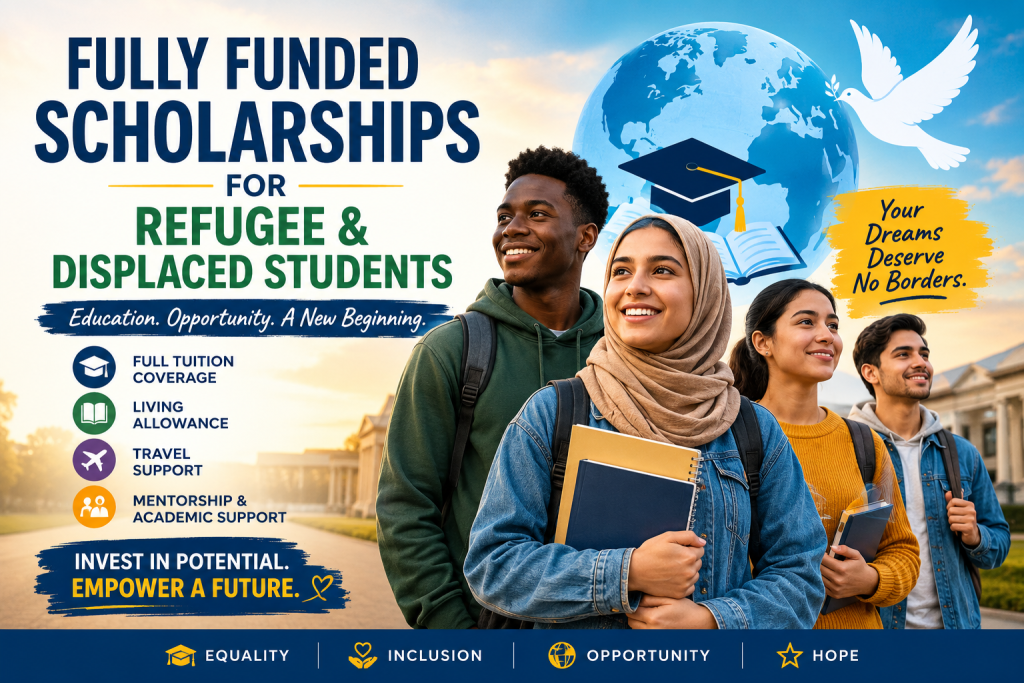
Every year, millions of people are forced to flee their homes due to conflict, persecution, and humanitarian crises like wars, terrorists’ attacks, communal disagreements and more. For many displaced individuals, the dream of a university education can feel impossibly out of reach but it doesn’t have to be. A growing number of fully funded scholarship programs exist specifically to help refugee and displaced students access quality higher education, rebuild their lives, and contribute to communities around the world.
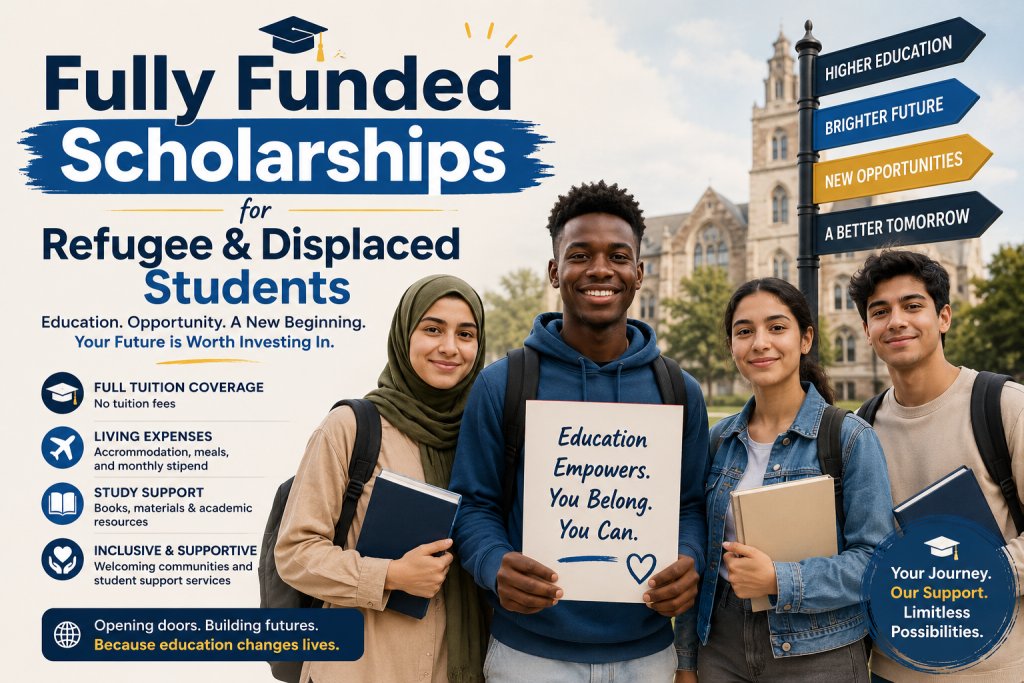
This guide provides the most impactful, fully funded scholarship opportunities available to refugees and displaced students in 2025 and 2026, covering eligibility requirements, application tips, and everything you need to know in order to get started.
Why Scholarships for Refugees Matter
According to UNHCR which is the UN Refugee Agency, only 6% of refugee students have access to higher education globally compared to a 40% global average for the general population. This education gap has devastating long-term consequences, both for individuals and the societies that host them.
Scholarships don’t just fund a degree.
They provide:
A pathway to economic independence and reduced reliance on aid.
Skills and qualifications that benefit host countries and communities of origin.
Psychological restoration, a sense of purpose, normalcy, and hope.
Long-term, peacebuilding, capacity, and educated refugees are disproportionately involved in post-conflict reconstruction.
The good news: the number of scholarship programs targeting refugees has expanded significantly in recent years, with major universities, governments, and NGOs all stepping up.
Top Fully Funded Scholarships for Refugees and Displaced Students
1. UNHCR’s Tertiary Refugee Scholarship known as Albert Einstein German Academic Refugee Initiative — DAFI
What it covers: Tuition fees, living expenses, study materials, and sometimes accommodation
Who can apply: Refugees registered with UNHCR in their country of asylum
Where it’s available: Over 50 countries
Deadline: Varies by country; usually applications open in late autumn
The DAFI Scholarship Programme is one of the longest-running and most respected scholarship initiatives for refugees worldwide. Established in 1992 with support from the German Federal Foreign Office, it funds undergraduate studies at national universities in host countries. Priority is given to students who demonstrate academic excellence, financial need, and community leadership potential.
To apply, candidates must contact their local UNHCR office directly. Selection is managed in-country, so eligibility and timelines differ by location.
2. Mastercard Foundation Scholars Program
What it covers: Full tuition, accommodation, meals, books, travel, and mentorship
Who can apply: Economically disadvantaged young Africans, including refugees and internally displaced persons (IDPs)
Partner universities: Over 30 institutions across Africa, the US, Canada, and beyond
Deadline: Varies by partner institution
The Mastercard Foundation Scholars Program is one of the most generous scholarship initiatives in the world. It not only funds education but wraps scholars in a comprehensive support system including academic tutoring, leadership training, career guidance, and community service requirements.
Refugees and displaced students from Sub-Saharan Africa are explicitly welcomed and encouraged to apply. Partner universities include institutions such as the University of Cape Town, Sciences Po, Cornell University, and the University of British Columbia.
3. Aga Khan Foundation International Scholarship Programme
What it covers: Up to 50% grant + 50% loan (effectively a full scholarship package)
Who can apply: Students from select developing countries, including those in displacement contexts.
Fields of study: All disciplines at postgraduate level
Deadline: Usually March–April each year
The Aga Khan Foundation International Scholarship supports outstanding postgraduate students who have no other means of funding their studies. While not exclusively for refugees, it prioritises applicants from marginalised and disadvantaged backgrounds making it highly accessible to displaced students from eligible countries including Afghanistan, Bangladesh, Egypt, Kenya, Pakistan, Nigeria, Tanzania, Uganda, and others.
4. CARA (Council for At-Risk Academics) Fellowships
What it covers: Academic fellowships, often with living stipends and research support
Who can apply: Academics, researchers, and advanced students at risk due to persecution or conflict
Where: UK universities
Deadline: Rolling applications
CARA specifically supports scholars including PhD candidates who face threats to their academic work due to political, religious, or ethnic persecution. The organisation places fellows at UK universities and provides emergency funding, academic mentorship, and resettlement support. It has helped over 4,000 academics since its founding in 1933.
If you’re an advanced student or early-career researcher who has been forced to flee, CARA is one of the most specialised and impactful pathways available.
5. Scholars at Risk (SAR) Network
What it covers: Temporary academic positions (visiting lectureships, research fellowships) with full support
Who can apply: Academics and researchers who face threats due to their scholarly work
Where: 500+ institutions in 40+ countries
Deadline: Ongoing
The Scholars at Risk Network protects scholars facing serious threats by arranging temporary positions at member universities worldwide. Positions usually last six months to two years and include housing assistance, stipends, and integration support. SAR works across all academic disciplines and has a particularly strong network in North America and Europe.
6. Kiron Open Higher Education
What it covers: Free online university courses and pathway programmes
Who can apply: Refugees and asylum seekers worldwide
Partner universities: Including FernUniversität in Hagen (Germany), Université Paris 8 France, and others
Deadline: Rolling enrolment
Kiron is a unique digital-first model that allows refugees to begin or continue university-level education entirely online, for free, before transitioning to on-campus study. It partners with real universities to offer accredited pathways, meaning the credits earned online can count toward a recognised degree.
Kiron is especially valuable for students in camps or remote areas without access to physical campuses, and for those still in the asylum application process.
7. University-Specific Refugee Scholarship Programmes
Many leading universities now run their own dedicated funding for displaced students.
Notable examples include:
University of Edinburgh (UK): Sanctuary Scholarships undertakes full tuition and living costs for asylum seekers and refugees.
University of Toronto (Canada): Boundless Promise Refugee Scholarship, full funding including housing.
Bard College (USA): Bard Refugee Initiative (BRI), free tuition and support for displaced students.
Sciences Po (France): Emile Boutmy Scholarship and dedicated refugee support.
TU Berlin (Germany): Integration grants and fast-track admissions for displaced students.
University of Melbourne (Australia): Refuge to Residence Scholarship, undertakes tuition, living allowance, and mentoring.
When applying to any university, always check whether they have a Sanctuary Scholarship, Refugee Scholarship, or Displaced Student Bursary programme, these terms are used interchangeably across institutions.
Who Is Eligible? Understanding Key Definitions
Eligibility for refugee scholarships typically depends on your legal status. Here are the main categories recognised by most programmes:
Status
Definition
Refugee
Formally recognised under the 1951 Refugee Convention; holds UNHCR refugee status
Asylum Seeker
Has applied for refugee status but is awaiting a decision
Internally Displaced Person (IDP)
Forced to flee within their own country; not always eligible for all programmes
Stateless Person
Not recognised as a national by any country
Humanitarian Protection
Subsidiary or temporary protection status granted by a host country
Always read eligibility criteria carefully before applying. Some scholarships require UNHCR registration; others accept asylum seeker status; and some platforms like Kiron are open to anyone in a displacement situation regardless of formal status.
Application Tips for Displaced Students
Applying for scholarships as a refugee or displaced student comes with unique challenges.
Here’s how to maximise your chances:
1. Gather documentation early: Most programmes require proof of refugee or asylum status, academic transcripts, and reference letters. If original documents were lost during displacement, contact UNHCR or relevant embassy services about obtaining certified copies or alternative documentation.
2. Write a compelling personal statement: Scholarship committees understand hardship but they want to see resilience, ambition, and a clear vision of what you’ll do with your education. Focus on your goals and the impact you intend to create.
3. Apply to multiple programmes simultaneously: There’s no shame in casting a wide net. Many scholarships complement each other, and applying broadly increases your chances significantly.
4. Leverage local NGOs and resettlement organisations: Organisations like the International Rescue Committee (IRC), Caritas, and local refugee councils often have advisors who can help identify scholarships, review applications, and provide translation support.
5. Don’t overlook online programmes: Kiron and similar platforms allow you to build an academic record even before you’re in a stable situation and these credits can count toward future degrees.
Additional Resources
UNHCR Higher Education Programme: unhcr.org/higher-education
DAFI Scholarship locator: Contact your local UNHCR office
Scholars at Risk: scholarsatrisk.org
Kiron Open Higher Education: kiron.education
CARA: cara.ngo
Mastercard Foundation Scholars: mastercardfdn.org/scholars
Conclusion
Being displaced from home either by conflict, persecution, and humanitarian crises like wars, terrorists’ attacks, communal disagreements is not enough to stop your dreams and aspirations.
However, the path from displacement to a university degree is not easy but it is possible, and thousands of students make that journey every year. Fully funded scholarships for refugee and displaced students exist across every continent and country, and at every level of education, from undergraduate programmes to doctoral fellowships.
The most important step is simply to start searching, start applying, and reach out to organisations like NGOs and agencies in your area who can support you through the process. Education is one of the few things that cannot be taken from you once you have it and for many displaced students, it becomes the foundation for everything that comes next and you too can have it, so start today.