The biggest myth holding Nigerian Ph.D applicants back is this: you need publications to get a scholarship abroad. You don’t. Thousands of Nigerian students have secured fully funded Ph.D positions at world-class universities in the UK, USA, Canada, Germany, Australia, and beyond without a single journal article to their name.
What you do need is a strategy
This publication will guide you through exactly how to apply for a Ph.D scholarship abroad from Nigeria with no known publications. It informs you on choosing the right programmes and writing a compelling research proposal to approaching potential supervisors and avoiding the mistakes that sink most applications.
Why Nigerian Students Without Publications Can Still Win Ph.D Scholarships
Publications are one signal of academic potential, but they are not the only one and for many Ph.D programmes, they are not even required.
Here is why:
Most Ph.D scholarships assess potential, not output. At the doctoral level, you are being trained to produce research. Admissions committees and scholarship panels are looking for evidence that you can think originally and rigorously and not that you have already published papers.
What many do not know is that the Nigerian academic system produces strong graduates without publications. Most Nigerian universities do not have a culture of undergraduate or master’s-level publishing, unlike institutions in the USA or Europe. International Ph.D programmes understand this context. A stellar academic record, a well-structured research proposal, and strong recommendation letters carry enormous weight.
Many fully funded scholarships explicitly welcome applicants from developing countries. Programmes like the Commonwealth Scholarship, DAAD, and Chevening are designed to support talent from countries like Nigeria, regardless of publication history.
All you need is knowing how to package your strengths convincingly.
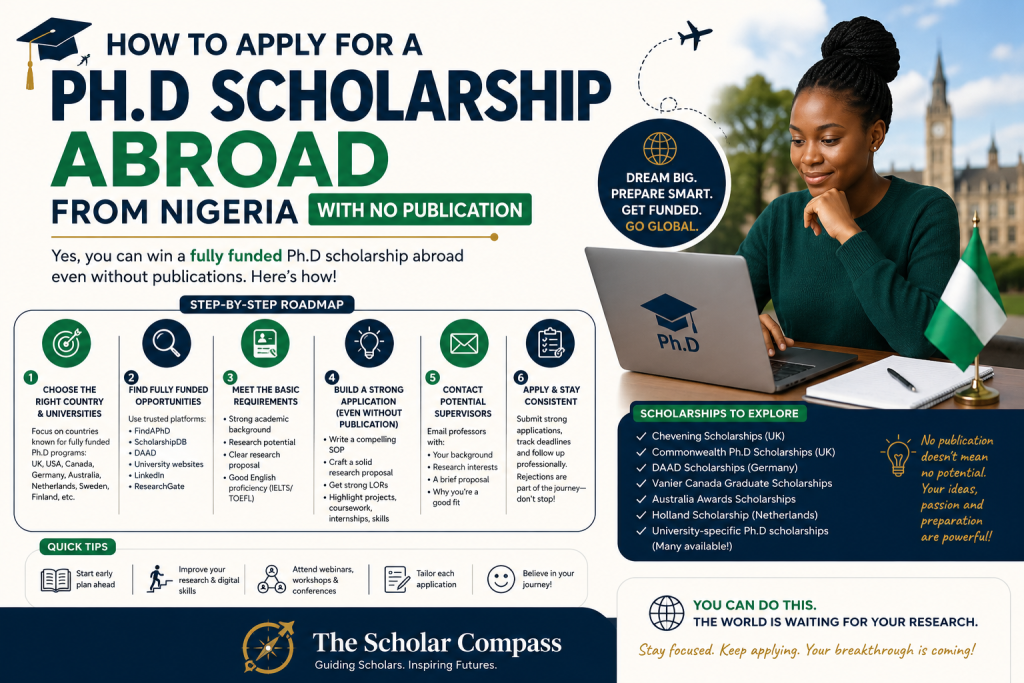
Step 1: Choose the Right Type of Ph.D Programme
Not all PhD programmes are created equal, and choosing the right structure significantly improves your chances with no publications.
Taught or Structured Ph.Ds in UK, Ireland, Canada
Many UK and Canadian universities offer structured Ph.D programmes that include coursework in the first year before transitioning to full research. These programmes are more open to applicants without publications because the expectation is that you will develop research skills during the programme itself.
Look for programmes at universities like the University of Edinburgh, University of Manchester, University of Toronto, and McGill University.
Funded Research Projects in UK, Germany, Netherlands
In Europe, many funded Ph.D positions are advertised as specific research projects attached to a supervisor’s grant. These roles don’t require a publication history but they require a good match with the project’s research theme. Check platforms like FindAPhD.com and EURAXESS regularly.
USA Ph.D Programmes with Funding Packages
American PhD programmes in STEM and social sciences almost always come with teaching or research assistantships that cover tuition and provide a living stipend. These are competitive, but publications are rarely required for applicants from African institutions. A strong GRE score, impressive transcripts, and a compelling personal statement can be enough.
Step 2: Build a Competitive Profile Without Publications
If you have no publications, you need to make other parts of your application exceptionally strong.
Here is how:
Strengthen Your Academic Record
Your undergraduate and master’s CGPA matters enormously. A first-class degree or distinction at the master’s level from a Nigerian university signals academic seriousness to international committees. If your grades are strong, lead with them.
Write a Research Thesis at Master’s Level
If you completed a master’s degree, your dissertation is your publication substitute. Treat it that way reference it prominently in your application, speak to its methodology, and highlight any original contributions it made to your field, this is why you need to be original in your thesis. A strong, well-defended thesis demonstrates exactly what a publication demonstrates: it portrays that you can conduct and communicate original research.
Attend and Present at Conferences
Conference presentations, especially at national or international conferences, are a credible alternative to journal publications. If you have presented a paper at any academic conference, even in a local Nigerian one include it in your CV. International scholarship committees recognise this as evidence of academic engagement.
Get Involved in Research Projects
Reach out to your professors, research institutes, or NGOs working in your field and ask to contribute to ongoing research even as a volunteer. Being listed as a research assistant or contributor on a working paper, policy brief, or technical report is meaningful experience that signals research readiness.
Step 3: Write a PhD Research Proposal That Stands Out
For most international Ph.D programmes, the research proposal is the single most important document in your application. This is where applicants with no publications can fully level the playing field.
A strong Ph.D research proposal from a Nigerian applicant should include:
A clearly defined research problem: Identify a specific, original gap in the existing literature. Avoid broad topics go narrow and deep.
A compelling rationale: Explain why this problem matters, who it affects, and why it is worth three to five years of rigorous investigation.
A realistic methodology: Outline your research design, data sources, analytical approach, and theoretical framework. Even if you refine this during the programme, showing methodological literacy is critical.
A Nigeria-informed perspective where necessary: Many international supervisors value applicants who bring non-Western research contexts and case studies to global academic conversations. If your research draws on Nigerian or African data, policy environments, or lived realities, frame that as a scholarly strength.
Alignment with your target supervisor’s work: Your proposal should echo and engage with the published work of the professor you want to supervise you. This shows you have done your homework and creates an immediate intellectual connection.
Keep your proposal between 1,000 and 2,000 words unless the programme specifies otherwise. Have it reviewed by a mentor or academic advisor before submission.
Step 4: Contact Potential Supervisors Before You Apply
One of the most powerful strategies for Nigerian Ph.D applicants and one of the least used is reaching out to potential supervisors directly, before submitting a formal application.
A well-crafted supervisor email:
Introduces you briefly and your academic background
Describes your research interest in one focused paragraph
Explains why their specific work resonates with yours
Asks whether they are accepting students and whether the topic seems viable
Professors who agree to supervise you before you apply will often advocate for you in the admissions process, increasing your chances dramatically. It also signals to the programme that you are a serious, proactive applicant qualities that compensate for the absence of publications.
Keep your email concise (under 300 words), professional, and specific. Avoid generic emails sent to dozens of professors, supervisors can tell, and it damages your credibility.
Step 5: Apply to the Right Scholarships
Here are the best Ph.D scholarships for Nigerians abroad that do not require a publication record:
Commonwealth Scholarship in UK
Commonwealth Scholarship UK, is one of the most prestigious and competitive scholarships available to Nigerian students. Covers full tuition, flights, and a monthly living allowance. Applications are submitted through the Nigerian government’s nominating agency. Strong academic records and a compelling development impact statement are the key criteria.
DAAD Scholarship in Germany
The German Academic Exchange Service funds hundreds of doctoral students from Nigeria annually. Germany has a strong research culture, and many DAAD-funded Ph.Ds are conducted in English. No publications required, only research potential and a clear project outline are prioritised.
Chevening Scholarship UK
Chevening Scholarship UK, is primarily a master’s scholarship but relevant as a pathway to Ph.D funding. Chevening scholars gain a UK master’s degree, after which many transition to fully funded Ph.D programmes with established UK supervisor relationships.
Fully Funded US PhD Assistantships
Instead of external scholarships, most American Ph.D funding comes through departmental teaching or research assistantships. Apply directly to Ph.D programmes in your field and indicate interest in funding during the application. STEM, public health, economics, and social science fields have particularly strong funding availability for international students including Nigerians.
Mastercard Foundation Scholars Program
Supports African students at partner universities including University of Toronto, McGill, and several African institutions. It covers full costs and is explicitly designed for students with leadership potential and social impact vision and not publication lists.
TETFund Scholarship by Nigeria Government
For Nigerians already employed in federal universities or polytechnics, the Tertiary Education Trust Fund (TETFund) offers overseas Ph.D sponsorship. This is a formal government funding channel worth exploring if you are already in academia.
Common Mistakes Nigerian Ph.D Applicants Make and How to Avoid Them
Applying too broadly without tailoring applications: A generic research proposal sent to ten universities performs worse than a targeted, personalised one sent to three. Streamline and customise every application.
Undervaluing their Nigerian academic experience: Nigerian degrees from strong institutions are well-regarded internationally. Don’t be apologetic about your background rather be proud and precise about what you have achieved.
Neglecting the personal statement: The personal statement is your opportunity to tell your story and your intellectual journey, your motivation, and your vision. A vague and generic personal statement loses scholarships that strong proposals deserve.
Missing deadlines: Most Ph.D scholarship deadlines fall between October and January for September intake. Create a spreadsheet, set reminders, apply early and be defined. Late applications are rarely considered.
Not preparing for interviews: Competitive scholarships like Commonwealth and DAAD often include interviews. Practise by articulating your research problem, its significance, and your methodology clearly and confidently.
Finally, Your Nigerian Background Is an Asset, Not a Barrier
Applying for a Ph.D scholarship abroad from Nigeria with no publications is absolutely achievable. The absence of a publication record is a circumstantial gap not a reflection of your intelligence, your potential, or your research readiness. The students who win these scholarships are not always the ones with the longest CVs. They are the ones with the clearest vision, the most compelling proposals, and the courage to apply.
Invest in your research proposal. Build genuine supervisor relationships. Apply to the right programmes. And remember that every Nigerian Ph.D scholar studying at Oxford, MIT, or Berlin today once sat where you are sitting now, wondering if they were ready.
They were. And so are you. Therefore, if they can you can too.
If you found this guide helpful? Share it with a fellow Nigerian student preparing for Ph.D applications abroad. The more we share, the stronger our community becomes.