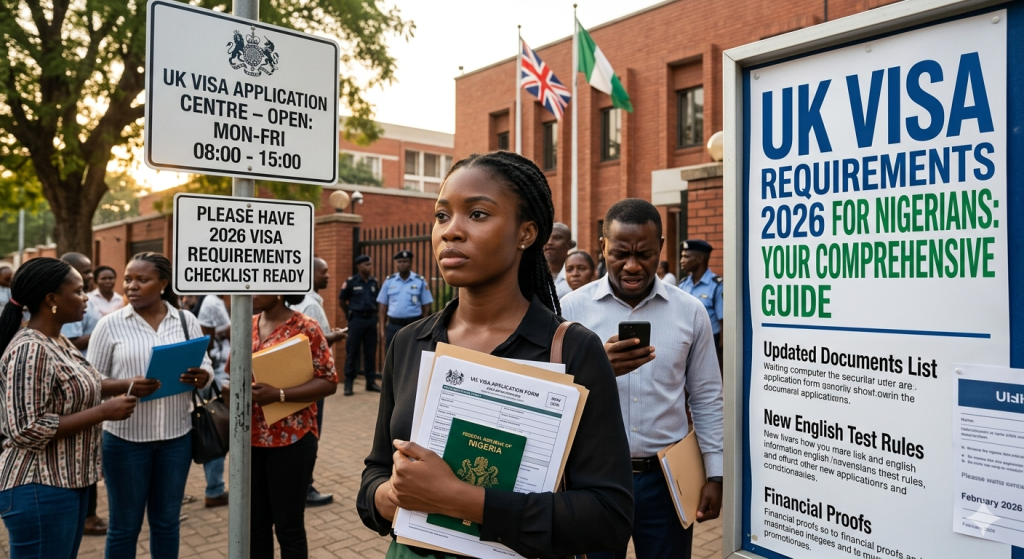
UK Student Visa Requirements for Nigerians: 2026 Guide
The United Kingdom remains one of the most popular study destinations for Nigerian students. From Russell Group universities in London and Edinburgh to world-ranked institutions in Manchester, Birmingham, and Nottingham, the UK offers academic programmes that are globally respected and career-defining. But before you can set foot on a UK campus, you must successfully navigate the UK Student Visa application process and for Nigerians, applying for a UK student Visa from Nigeria involves several requirements including admission from a licensed student sponsor, a Confirmation Acceptance Studies (CAS), evidence of finances where required, identity document and, for foe applicants living in Nigeria, a Tuberculosis(TB) certificate.
This guide covers everything you need to know about UK Student Visa requirements for Nigerians in 2026, including the documents you must submit how to submit it and when to submit it, financial thresholds, English language requirements, biometrics, the tuberculosis (TB) test, and how to avoid the most common reasons for rejection.
Quick Summary: Nigerian students applying for a UK Student visa generally need a valid passport or travel document, a Confirmation of Acceptance for Studies (CAS), evidence of English-language ability where required, financial evidence where required, and any additional documents applicable to their circumstances. Applicants who meet the UK’s TB-screening rules must obtain a certificate from an approved clinic. You must also pay the Student visa application fee and Immigration health surge where applicable.
What Is the UK Student Visa?
The UK Student Visa before now was known as the Tier 4 Student Visa, which is the official visa category for international students aged 16 and above who wish to study a course longer than six months at a UK Home Office-licensed educational institution. Therefore, for Nigerian students pursuing undergraduate, postgraduate, or foundation programmes in the UK, this is the visa you need.
It is important to distinguish this from the Short-Term Study Visa, which covers courses of six months or less and does not permit work or extensions. If you are for full degree programmes, the UK Student Visa is the correct route.
Who Qualifies for a UK Student Visa from Nigeria?
To be eligible for a UK Student Visa as a Nigerian applicant, you must:
Be 16 years of age or older
Have been offered a place on a course by a UK Visas and Immigration (UKVI)-licensed sponsor (your university or college)
Prove your English language ability to the required standard
Have enough money to cover your tuition fees and living costs
Provide a valid Nigerian international passport
Not fall under any immigration ban or criminal disqualification
Meeting these conditions is the foundation of a successful application. Let us now go through each requirement in detail.
1. Confirmation of Acceptance for Studies (CAS)
The CAS number is the single most important document in your UK Student Visa application. It is a unique 14-character reference code issued by your UK university or college once you have accepted an unconditional offer and paid any required deposit.
Your CAS contains key information including:
Your course name, level, and duration
The start and end dates of your programme
Your tuition fee amount
Any conditions attached to your offer
You cannot apply for a UK Student Visa without a CAS number. Once your university issues your CAS, you typically have a limited window which is usually three months to submit your visa application. Do not delay.
2. Valid Nigerian International Passport
You must provide a current passport or other valid travel document when applying. Make sure the personal details on your application, passport and supporting documents are consistent, and follow UKVI instructions about the travel document you will use for the application and travel. UK Visas and Immigration requires that your passport has at least one blank page for the visa vignette.
If your Nigerian passport is due to expire during your studies, renew it before applying. Also ensure the name on your passport exactly matches the name on your university offer letter and CAS any discrepancy can cause delays or rejection.
3. English Language Proficiency
You must demonstrate English proficiency through a UKVI-approved Secure English Language Test (SELT).
The most widely accepted tests for UK Student Visa purposes are:
IELTS for UKVI
The most commonly used test.
For most undergraduate and postgraduate programmes, universities require:
Overall band score: 6.0–6.5 with no individual component below 5.5–6.0.
Higher-ranked universities and competitive programmes (Law, Medicine, Business) often require 6.5–7.5
Note: Regular IELTS Academic is accepted by universities for admissions purposes, but IELTS for UKVI (taken at a UKVI-approved centre) may specifically be required for visa purposes at some institutions. Confirm with your university which version they need.
LanguageCert International ESOL SELT
An increasingly accepted alternative to IELTS for UKVI purposes. Check UKVI’s official approved test list for the most current options.
Exemptions
You may be exempt from the English language requirement if:
You are a national of a majority English-speaking country (Nigeria does not qualify for this exemption)
You have previously studied for a degree taught in English at a UK institution
Your A-Level or equivalent qualifications were taught and assessed in English at a recognised institution but this is assessed case by case and is not guaranteed
4. Financial Requirements: Proof of Funds
This is where many Nigerian applicants face difficulties. The UK Home Office requires you to prove you have enough money to pay for your tuition fees and living costs before and during your studies.
Outside London £1,171 per month, up to 9 months.
Maximum living-cost evidence: £10,539 London £1,529 per month, up to 9 months.
Maximum: £13,761 These figures are from the current Immigration Rules/UK government guidance.
GOV.UK +1
The applicant must generally show the required funds for 28 consecutive days, with the end of that period within the specified timeframe before application.
How Much Money Do You Need?
As of 2026, the financial thresholds are:
Study Location
Required Monthly Living Cost
Duration
London
£1,334 per month
Up to 9 months
Outside London
£1,023 per month
Up to 9 months
You must also show funds to cover your full first-year tuition fee (or the remaining balance if you have already paid a deposit).
Example calculation:
Studying in London, 9-month course: £1,334 × 9 = £12,006 living costs
Plus £15,000 first-year tuition = £27,006 total minimum funds required
How Long Must Funds Be Held?
The required funds must have been held in your (or your sponsor’s) bank account for a continuous period of at least 28 days before the date of your visa application. The closing balance on the 28th day must be at or above the required amount — a single dip below the threshold during that period is grounds for refusal.
Acceptable Proof of Funds Documents
Personal bank statements (showing 28 consecutive days of balance)
Parent or guardian bank statements (with a letter of sponsorship)
Official scholarship or bursary award letter (from a government body or recognised organisation)
Fixed deposit or investment account statements
5. Tuberculosis (TB) Test is mandatory for Nigerians
This requirement catches many Nigerian applicants off guard. Nigeria is on the UK’s list of countries where applicants must provide a TB test certificate when applying for a UK Student Visa for courses lasting longer than six months.
You must take the TB test at a UKVI-approved clinic in Nigeria. The approved clinics are located in Lagos and Abuja. The test involves a chest X-ray and, where necessary, a sputum test. Results are typically available within three to five working days, and a clear TB certificate is valid for six months from the date of the test.
Do not book your visa appointment before receiving your TB test results. A missing or invalid TB certificate will result in automatic refusal.
Approved TB testing centres in Nigeria (2026):
In Nigeria, there are several hospitals both private and government owned but only these few are selected for Turberculosis test for international students.
Lagos: CLINA-LANCET Laboratories, Victoria Island
Abuja: CLINA-LANCET Laboratories, Wuse II
Always verify the current list on the official UK government website before booking, as approved centres can change.
6. UK Student Visa Application Fee and Immigration Health Surcharge (IHS)
Visa Application Fee
The UK Student Visa application fee for applicants outside the UK is currently £558 under the current Home Office , 2026 rate. This fee is non-refundable, even if your application is refused. The immigration health surcharge is seperate from the visa application fee and depends on the length of immigration permission.
Immigration Health Surcharge (IHS)
In addition to the visa fee, Nigerian students must pay the Immigration Health Surcharge, which grants access to NHS services during your stay. As of 2026, the IHS rate for students is £776 per year of your course.
For a three-year undergraduate degree, this means:
IHS: £776 × 3 = £2,328
Visa fee: £490
Total upfront cost: approximately £2,818, this is before any travel or document costs.
Plan for this well in advance. The IHS must be paid in full at the time of your online visa application, and you will not be issued a visa without it.
7. Additional Supporting Documents
Beyond the core requirements, Nigerian applicants are typically expected to submit the following supporting documents:
Academic qualifications:- WAEC/NECO results, A-Level certificates, university transcripts as applicable.
Passport-sized photographs:- meeting the UK government’s strict photo guidelines.
ATAS certificate :- If your course falls under the Academic Technology Approval Scheme which is relevant for certain STEM and research programmes at postgraduate level.
Parental consent letter :- If you are under 18 years of age.
Evidence of previous study in the UK :- If you are extending or changing your visa status.
Official letter from your employer :- If you are a sponsored student or on a professional development programme.
8. Biometric Appointment (UK Visa Application Centre)
After submitting your online application and paying your fees, you must book a biometric appointment at a UK Visa Application Centre (UKVCAC) in Nigeria. There are centres in Lagos and Abuja. At your appointment, your fingerprints and a facial photograph will be taken.
Bring all your original documents to the biometric appointment not photocopies but original. The centre will scan and submit them on your behalf, or you can use the premium document-scanning service for faster processing.
UK Student Visa Processing Time for Nigerian Applicants
Standard UK Student Visa processing time is approximately three weeks (15 working days) from the date of your biometric appointment. However, Nigerian applicants should build in extra time for the TB test, document gathering, and any potential requests for additional information from UKVI.
You may apply for your visa no earlier than six months before your course start date.
Recommended timeline for Nigerian applicants:
6 months before course start: Receive unconditional offer and CAS
5 months before: Book and complete TB test; gather all documents
4.5 months before: Submit online visa application and pay fees
4 months before: Attend biometric appointment
3 weeks later: Receive visa decision
Common Reasons UK Student Visa Applications Are Refused for Nigerians
Understanding why applications fail is just as important as knowing what to submit. The most frequent grounds for refusal among Nigerian applicants include:
Insufficient or incorrectly documented funds:- Funds not held for 28 days, or balance dropping below threshold during the period
Missing TB test certificate :- Overlooked or booked too late.
English language test not UKVI-approved:- Submitting a non-SELT IELTS result where a SELT is required.
Inconsistencies between documents:- Name spelling differences between passport, CAS, and bank statements.
Unconvincing intention to leave the UK after studies ;- weak ties to Nigeria.
Expired or soon-to-expire passport :- Passport validity does not cover the full course duration.
UK Student Visa Requirements Checklist for Nigerians in 2026
Requirement
Details
CAS Number
Issued by your UK university after unconditional offer
Valid Passport
Must cover full course duration; one blank page minimum
English Language Test
IELTS for UKVI (6.0–6.5+) or UKVI-approved SELT
Proof of Funds
Tuition + £1,334/month (London) or £1,023/month (outside London), held 28 days
TB Test Certificate
From UKVI-approved clinic in Lagos or Abuja
Visa Application Fee
£490 (non-refundable)
Immigration Health Surcharge
£776 per year of course
Academic Qualifications
WAEC, A-Levels, transcripts as applicable
Passport Photographs
UK government specification
Biometric Appointment
At UKVCAC in Lagos or Abuja
If you apply from outside the UK, UKVI says you will usually receive a decision within 3 weeks, although processing times can vary.
In Conclusion: Apply Early, Apply Right
To be on a safe side, give yourself a minimum of four to five months between receiving your CAS and your intended travel date. Gather your documents methodically, ensure your funds meet the threshold for the full 28 days, book your TB test early, and double-check every document for consistency.