

The opportunity to study abroad from Nigeria is one of the most transformative decisions a student can make. It opens doors to world-class education, international career networks, and life experiences that no classroom within Nigeria’s borders can fully replicate. But before you board that flight to London, Toronto, Berlin, or Washington D.C., there is a set of requirements you must meet and your ability to understand them clearly makes the difference between a successful application and a costly rejection.
This guide covers everything Nigerian students need to know about the requirements to study abroad in 2026, from academic qualifications and language tests to visa documentation and financial readiness.
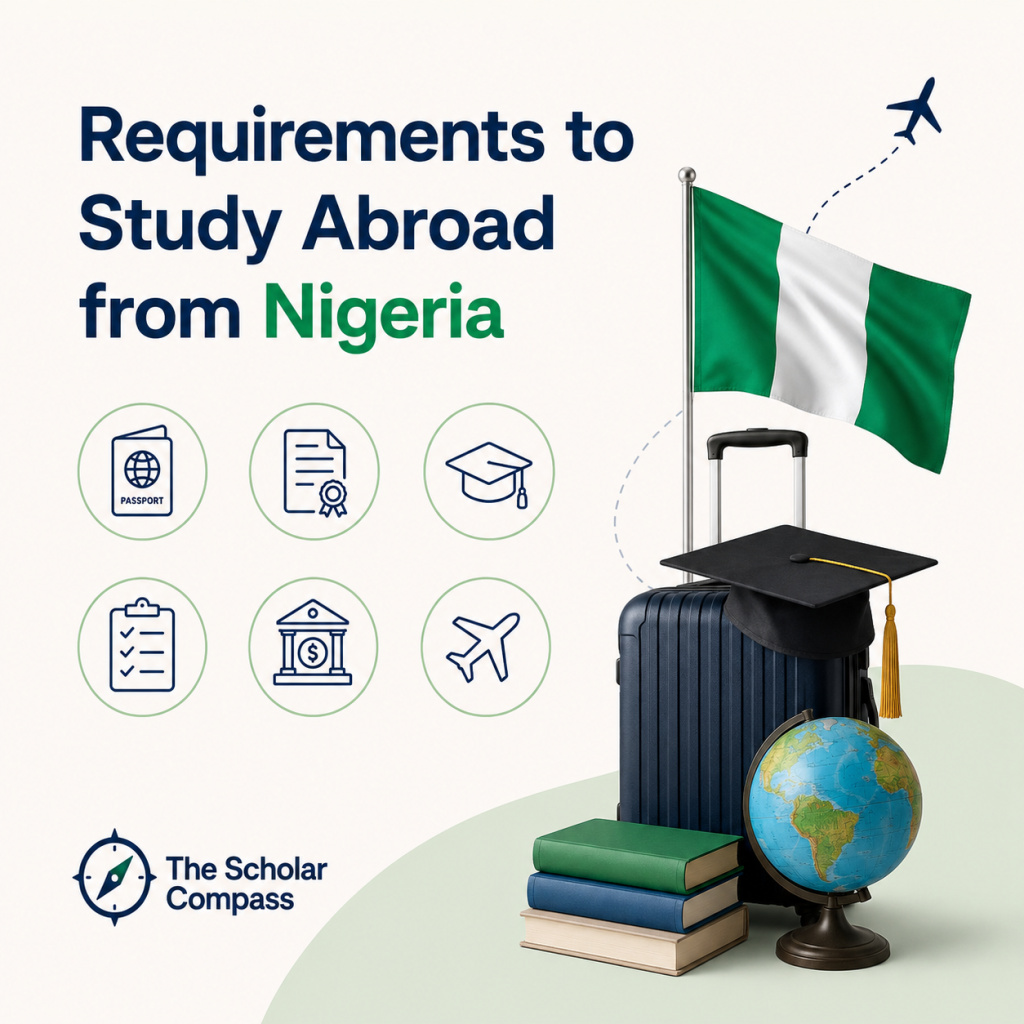
Why Understanding Study Abroad Requirements Matters
Alot of Nigerian students begin the international admissions process without a clear picture of what universities and embassies actually demand. They submit incomplete applications, miss critical deadlines, or discover too late that their WAEC results alone are not sufficient for direct undergraduate entry at many foreign institutions. Knowing the full requirements to study abroad from Nigeria well in advance gives you the time to close any gaps and submit the strongest possible application.
The requirements fall into several broad categories: academic qualifications, language proficiency, standardised tests, financial documentation, visa requirements, and health/travel preparation. Let us walk through each one in detail.
1. Academic Qualifications and Transcripts
The first thing any foreign university will assess is your academic record. For Nigerian students, this typically means the following:
WAEC / NECO O’Level Results
Your West African Senior School Certificate (WASSCE) or National Examinations Council (NECO) results are the Nigerian equivalent of secondary school leaving qualifications. Most universities abroad particularly in the UK, Canada, and the USA require a minimum of five credits, including English Language and Mathematics, at no more than two sittings.
Some competitive universities and programmes require credits in subject-specific O’Level papers relevant to your intended course of study (e.g., Biology and Chemistry for Medicine, or Further Mathematics for Engineering).
A-Levels, Cambridge Pre-U, or Foundation Programmes
Many international universities do not offer direct undergraduate entry based on O’Level results alone.
Nigerian students often need one of the following:
A-Level qualifications (Cambridge International A-Levels are widely accepted)
A recognised foundation or pathway programme offered by the target university or a partner institution
International Baccalaureate (IB) Diploma
If you completed your secondary education in Nigeria without A-Levels, a foundation year at your target university or at a pathway college such as Kaplan, INTO, or Study Group is typically the recommended route before entering a full undergraduate degree programme.
University Transcripts (for Transfer Students)
If you are already studying at a Nigerian university and wish to transfer or continue abroad, you will need official transcripts from your current institution, showing all completed courses, grades, and your current CGPA. Most foreign universities require a minimum CGPA of 3.0 on a 5.0 scale which is equivalent to second-class lower as a baseline, though competitive programmes expect 3.5 and above.
2. English Language Proficiency Tests
English may be Nigeria’s official language, but most foreign universities still require formal proof of English proficiency from Nigerian applicants. This is because the medium of instruction at home and the consistency of English standards varies widely across Nigerian institutions.
The most widely accepted English language tests include:
International English Language Testing System (IELTS)
IELTS is the most commonly required English test for Nigerian students applying to UK, Canadian, and Australian universities. Most undergraduate programmes require a minimum overall band score of 6.0 to 6.5, with no individual band (Reading, Writing, Listening, Speaking) falling below 5.5 or 6.0 depending on the institution.
Top universities such as those in the Russell Group (UK) or the U15 Group like Canada may require 6.5 to 7.0 overall.
Test of English as a Foreign Language TOEFL iBT
TOEFL iBT is widely preferred by American and some Canadian universities. A competitive score for most undergraduate programmes is between 80 and 100 out of 120. Ivy League and top US universities often require 100 or above.
Duolingo English Test
An increasingly accepted alternative, the Duolingo English Test is cheaper and can be taken online. Many universities now accept scores of 110 to 120 for undergraduate admissions. Check individual university policies before relying on this option.
PTE Academic
Pearson’s PTE Academic is accepted by thousands of universities globally and is popular among Nigerian students applying to Australia and the UK. Minimum scores typically range from 50 to 65.
Pro Tip: Some universities waive the English language requirement for Nigerian students who completed their O’Level and A-Level education entirely in English at a Nigerian institution but this is not universal. Always confirm directly with the admissions office.
3. Standardised Admissions Tests
Depending on your destination country and programme, you may need to sit additional standardised tests:
SAT / ACT (United States)
Most US universities require either the SAT or ACT for undergraduate admissions. Competitive scores for moderately selective universities are 1100–1300 on the SAT and 22–28 on the ACT. Top-ranked US universities (Ivy League, MIT, Stanford) typically expect 1450+ on the SAT. Note that a growing number of US universities have adopted test-optional policies post-COVID, so check each school’s current requirements.
UKCAT / UCAT (UK — Medicine)
Nigerian students applying to study Medicine at a UK university must sit the UCAT (University Clinical Aptitude Test) as part of their application. Some medical schools also accept or require the BMAT (BioMedical Admissions Test).
GMAT / GRE (Postgraduate for planning purposes)
While not relevant for undergraduate entry, Nigerian students who intend to continue to postgraduate study should be aware that many master’s programmes in the USA and Canada require GMAT for business related courses or GRE for other disciplines.
4. Financial Requirements and Proof of Funds
One of the most significant requirements to study abroad from Nigeria is demonstrating that you can finance your education. Universities and embassies both require this.
University Financial Requirements
At the point of receiving your offer letter or conditional acceptance, most universities will ask for proof that you can cover:
First-year tuition fees (ranging from £10,000–£38,000 per year in the UK; $20,000–$60,000 in the USA)
Living expenses for the duration of your course
Visa Financial Requirements
For your student visa, the relevant embassy will also require proof of funds. For a UK Student Visa, for example, you must show you can cover tuition plus at least £1,334 per month for living costs in London (or £1,023 outside London), held in your account for at least 28 consecutive days before your visa application.
Acceptable financial documents typically include:
Bank statements (personal, parental, or sponsor)
Scholarship award letters
Affidavit of financial support (for sponsored students)
Fixed deposit certificates
5. Valid International Passport
A valid Nigerian international passport is an absolute prerequisite. Your passport must be valid for the entire duration of your intended programme of study most embassies require at least six months’ validity beyond your planned return date. If your passport is due to expire during your studies, renew it before applying.
Begin your passport application or renewal early, as processing times at the Nigerian Immigration Service can be unpredictable.
6. Student Visa Requirements
Each destination country has its own student visa process. Here is a brief overview for the most popular destinations among Nigerian students:
UK Student Visa (formerly Tier 4)
Unconditional offer from a UK Home Office-licensed sponsor university
Confirmation of Acceptance for Studies (CAS) number from the university
IELTS or equivalent English test results
Proof of funds (tuition + living costs for up to 9 months)
Valid passport and recent passport photographs
Tuberculosis (TB) test result from an approved clinic in Nigeria (mandatory for Nigerian applicants)
Application fee: approximately £490 (2026 rate; subject to change)
USA F-1 Student Visa
Form I-20 issued by the US university after acceptance
SEVIS fee payment (currently $350)
DS-160 online visa application form
Proof of financial support
IELTS or TOEFL scores
Visa interview at the US Embassy in Abuja or Consulate in Lagos
Strong ties to Nigeria (evidence of intent to return after studies)
Canada Study Permit
Acceptance letter from a Designated Learning Institution (DLI)
Proof of financial support (tuition plus approx. CAD $10,000 for living costs)
Valid passport
Biometrics
Statement of purpose (Letter of Explanation)
No criminal record certificate
Germany Student Visa
University admission letter
Blocked account (Sperrkonto) with a minimum of €11,208 (2026 requirement)
Health insurance
Academic qualifications with certified German translations
German or English proficiency proof (depending on the programme)
7. Additional Requirements Nigerian Students Often Overlook
Beyond the core checklist, there are several supporting requirements that Nigerian students frequently underestimate:
Notarised and Certified Document Copies: Many universities require notarised copies of your academic certificates, translated into English or the host country’s language where applicable.
Statement of Purpose / Personal Statement: A compelling, well-written essay explaining your motivation for studying abroad, your chosen programme, and your career goals is required by virtually every university.
Letters of Recommendation: Two to three academic or professional references are standard for most international university applications.
Medical/Health Insurance: Many countries require incoming students to hold valid health insurance from day one of arrival. Some universities offer institutional plans; others require private coverage.
Vaccinations and Medical Fitness: Countries like Canada and Australia may require evidence of specific vaccinations. Some US universities require meningitis vaccines before campus registration.
Study Abroad Requirements Checklist for Nigerian Students in 2026
Requirement
Details
O’Level Results (WAEC/NECO)
Minimum 5 credits including English & Maths
A-Levels / Foundation Programme
Required for most direct undergraduate entry
University Transcripts
Needed for transfer applicants
English Proficiency Test
IELTS, TOEFL, Duolingo, or PTE
Standardised Tests
SAT/ACT for USA; UCAT for UK Medicine
Valid International Passport
Valid throughout full study duration
Proof of Funds
Bank statements, scholarship letters
Student Visa
Country-specific (UK, USA, Canada, Germany)
Personal Statement / SOP
Tailored to each university and programme
Letters of Recommendation
2–3 referees (academic or professional)
Notarised Document Copies
Certified translations where required
Health Insurance
Mandatory in most study destinations
In Conclusion: Prepare Early, Apply Confidently
The requirements to study abroad from Nigeria are feasible especially if you approach the process with enough time, organisation, and focus. Many Nigerian students who miss out on international study opportunities do so not because of weak academics, but because they discovered a missing requirement too late in the process.
Start now to build your checklist. Register for your English language test six to twelve months before your target intake. Gather your academic documents early and have them notarised. Research the specific visa requirements for your destination country. And above all, give yourself enough runway to put together an application that truly reflects your ability, ambition, and potential.
Nigeria has produced world-class professionals, researchers, and leaders across every field. The global stage is waiting and knowing exactly what is required is the first step to claiming your place on it.
