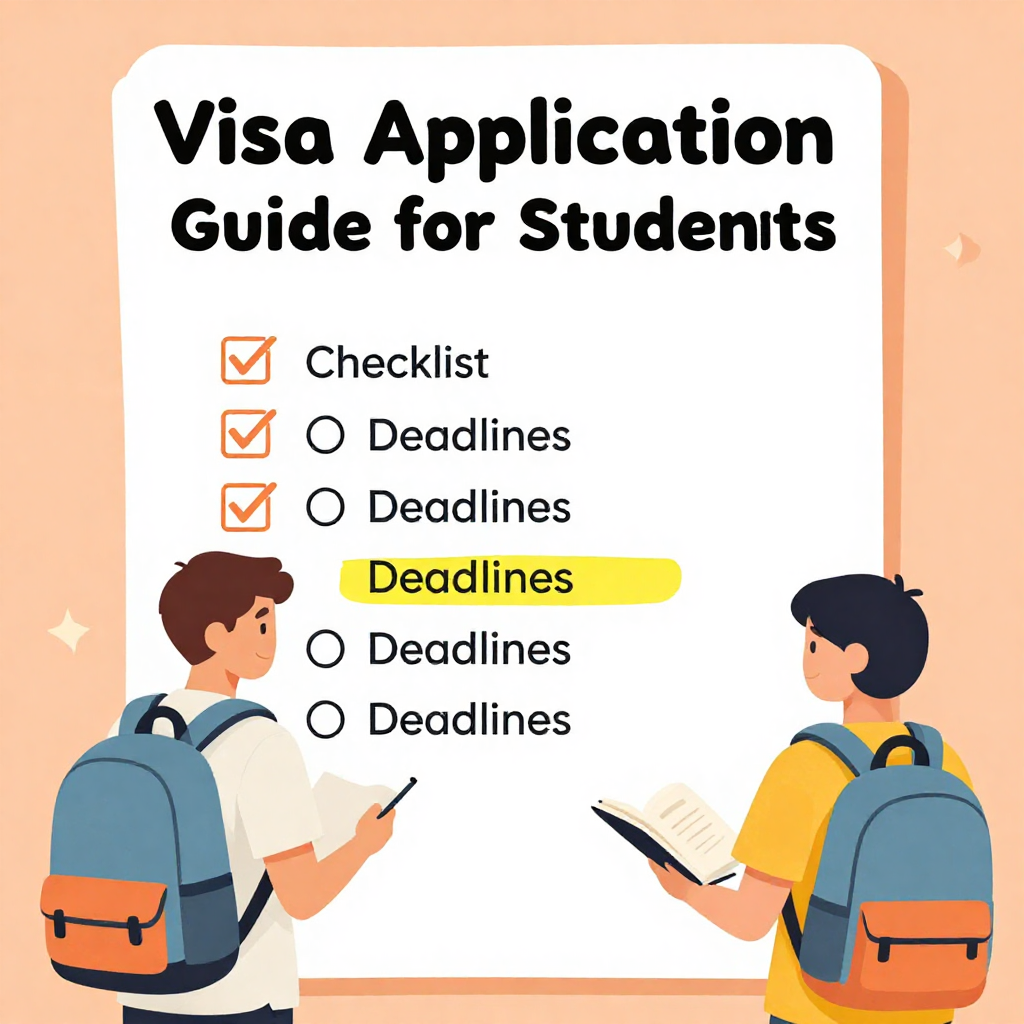
Visa Application Guide for Students: 5 Key Steps, From Someone Who Almost Missed his Own Flight
Table of Contents
Introduction: The Email That Almost Didn’t Come
Step 1: Get Your Offer Letter and Confirmation of Acceptance in Order First
Step 2: Sort Your Finances Before You Touch the Application Form
Step 3: Book Your Biometrics and Medical Checks Early, Not “Eventually”
Step 4: Fill the Application With Painful Honesty, Not Guesswork
Step 5: Prepare for the Interview Like It’s a Conversation, Not an Interrogation
Mistakes I Made, So You Don’t Have To
Frequently Asked Questions
Final Thoughts
Introduction: The Email That Almost Didn’t Come
Studying abroad is a life-changing opportunity, but before you can step into your dream university, you must secure a student visa. For many students, the visa application process can feel overwhelming due to strict requirements, documentation, and timelines. Below is someone’s experience who almost lost his own as a result of the hurdles attached to the visa processes and this the reason I believe this will guide whoever this reading this.
I still remember refreshing my email every hour for what felt like a week straight, convinced that my visa application had disappeared into some bureaucratic black hole. I’d done everything “right” or so I thought. Filled the form, paid the fee, attached documents in the order the checklist suggested. And yet, three days before my flight was supposed to leave, I still hadn’t heard back.
What I didn’t know then, and wish someone had told me plainly, was that a student visa application isn’t really one big task. It’s five smaller, very specific steps, and almost every delay, rejection, or last-minute panic I’ve seen mine included traces back to rushing or misunderstanding one of those five. Not bad luck. Not a “difficult” embassy. Just a missed detail in a process that rewards precision far more than enthusiasm.
This isn’t a copy-paste checklist pulled from an embassy website. It’s what actually happened when I went through it, what I got wrong, and what I’d tell a friend sitting where I was sitting with my laptop open, documents half-scanned, panicking quietly at 11pm the night before a deadline.
If that’s you right now, take a breath. This is doable, and it’s more procedural than personal meaning it responds to precision and timing far more than it responds to worry.
Step 1: Get Your Offer Letter and Confirmation of Acceptance in Order First
Nothing else in your visa application matters until this document is fully correct. Your Confirmation of Acceptance for Studies (CAS) in the UK, I-20 in the US, or equivalent acceptance letter isn’t just proof you got in, it’s the anchor document that every other part of your visa application references: your program dates, your tuition amount, your institution’s accreditation details.
Here’s what I didn’t check carefully enough the first time: the spelling of my name on the CAS didn’t exactly match my passport, a missing middle initial. It seems small. It is not small to a visa officer cross-referencing documents. I had to request a corrected letter from my university’s admissions office, which took four business days I genuinely didn’t have to spare.
What to actually do:
Cross-check every spelling, date, and number on your offer letter against your passport, not from memory.
Confirm your course start date lines up with realistic visa processing timelines in your country, some embassies take 3 weeks and others take 12.
Save both a digital and printed copy; some visa centers still don’t accept phone screenshots.
Step 2: Sort Your Finances Before You Touch the Application Form
This is the step people underestimate the most, and it was the one that nearly broke me emotionally, not just logistically. Financial proof requirements are rarely just “show you have money.” Most countries want to see that the money has been in your account for a specific minimum period often 28 days for UK student visas, for example; sitting untouched, not deposited the week before you apply.
I moved money into my account nine days before applying, thinking it would be fine. It wasn’t. The embassy flagged it, and I had to wait out the full holding period again, watching my intended travel date get closer with every passing day.
What to actually do:
Confirm the exact minimum holding period required for your specific visa category don’t assume it’s the same as a friend’s country or visa type.
If a sponsor such as parent, guardian is funding you, get their sponsorship letter and supporting bank documents ready in parallel, not after.
Keep bank statements as official-format PDFs from your bank’s portal, not screenshots of a mobile app.
Step 3: Book Your Biometrics and Medical Checks Early, Not “Eventually”
I treated biometrics appointments like an errand I’d “get to.” They are not an errand. In several countries, biometric appointment slots book out weeks in advance, especially during peak intake seasons (August–September and January intakes see the worst backlogs).
I ended up traveling four hours to a biometrics center in a different city because every slot near me was booked solid for three weeks, three weeks I did not have before my program’s start date.
What to actually do:
Book your biometrics appointment the moment your application is submitted, not after you assume it’s “probably fine.”
If a medical exam like a TB test for certain visa categories is required, confirm which specific clinics are embassy-approved not just any clinic, or your results won’t count.
Build in at least a 2-week buffer between your biometrics appointment and your intended travel date.
Step 4: Fill the Application With Painful Honesty, Not Guesswork
This is the step where I’ve seen the most well-meaning people talk themselves into trouble not through lying, but through guessing. Guessing a date because you don’t have the document in front of you. Guessing an address because you moved recently and aren’t sure of the postal format. Small inconsistencies between your application and your supporting documents are one of the most common, and most avoidable, reasons for delay or refusal.
I once wrote my intended length of stay slightly differently on two separate forms not dishonestly, just carelessly, because I filled them on different days without cross-referencing. It triggered a request for clarification that added two more weeks to my timeline.
What to actually do:
Fill the form only when every source document is open in front of you, never from memory.
Use the exact same phrasing, date formats, and spellings across every document you submit.
If a question doesn’t clearly apply to you, don’t guess please check the official guidance notes or contact the visa center directly.
Step 5: Prepare for the Interview Like It’s a Conversation, Not an Interrogation
Not every visa category requires an interview, but if yours does, this is the step that broke my nerves the most and the one where I now realize I over-prepared for the wrong thing. I’d memorized answers like a script. The problem is, visa officers notice memorized answers, and they read as evasive even when you’re telling the complete truth.
What actually helped, the second time I had to do this (for a visa renewal), was preparing themes, not scripts: why this course, why this country, what happens after you finish, how you’re funding it. Real, honestly-worded answers, even slightly imperfect ones, consistently land better than a polished paragraph that sounds rehearsed.
What to actually do:
Know your own documents well enough to speak about them naturally things like your funding, your course structure, your return or post-study plans.
Practice out loud with a friend, not just in your head the awkwardness of speaking answers exposes gaps memorization hides.
Bring a physical copy of every document you’ve submitted digitally, in an organized folder, even if you’re told it’s “not required.”
Mistakes I Made, So You Don’t Have To
Applying with a “close enough” bank statement. It has to match the exact required format and duration, so no exceptions.
Assuming embassy processing time = calendar time. Public holidays and appointment backlogs are not counted in the “standard processing time” they advertise.
Treating the checklist as optional flavor text. Every visa checklist item exists because someone before you got rejected for skipping it.
Not having a backup travel date. I booked a non-refundable flight before my visa was approved. Don’t do that.
Underestimating translation requirements. If any document isn’t in the required language, it often needs a certified translation, not just a personal one.
Frequently Asked Questions
How far in advance should I start my student visa application?
Ideally 3–4 months before your program start date, and never less than 6–8 weeks even for “fast” visa categories appointment backlogs, not form-filling, are usually what eat your timeline.
Can a visa be refused for reasons that have nothing to do with my documents?
Yes — inconsistent answers between your written application and interview, unclear post-study intentions, or even a visa officer’s concern about “genuine student intent” can factor in, separate from paperwork completeness. This is rarely discussed but is a real, subjective layer of the process.
If my visa is refused, does that affect future visa applications to other countries?
Not usually directly, since most countries don’t share refusal records with each other, but you are typically required to disclose a prior refusal on future applications and failing to disclose it honestly is treated far more seriously than the original refusal itself.
Does having dependents or a spouse complicate a student visa application?
Yes, meaningfully, dependent visas often have separate financial proof requirements stacked on top of your own, and timing them together (rather than sequentially) is something few guides explain clearly, which can cause avoidable delays if not planned as one combined timeline.
Can social media activity affect a student visa decision?
In some countries’ visa systems, public social media profiles can be reviewed as part of background checks, particularly for consistency with your stated travel and study intentions. It’s uncommon knowledge, but worth knowing that your public-facing online presence isn’t entirely separate from your application.
Is it normal to feel anxious throughout this process, and does that affect the outcome?
It’s completely normal, and no, your anxiety doesn’t factor into the decision, only your documents and answers do. But that anxiety is real enough that it’s worth telling someone you trust what you’re going through instead of carrying the stress alone through the entire process.
What happens if my course start date is delayed but my visa is already issued?
You’ll usually need to inform your institution and, in many cases, the visa authority directly because visas are often tied to specific program dates, and an undisclosed mismatch between your visa validity and your actual start date can cause issues at border entry, even with an approved visa in hand.
Do all countries require the same minimum bank balance duration?
No — this varies significantly by country and visa category (28 days is common for UK visas, but other countries use different rules or none at all), so always verify the specific requirement for your destination rather than assuming based on what a friend experienced elsewhere.
Final Thoughts
If there’s one thing I’d want you to take from this, sitting wherever you are right now with tabs open and a deadline looming, it’s this: almost nothing about this process is about you as a person. It’s about precision, timing, and consistency across documents. I mean things you can control, slowly and carefully, even under stress.
I got through it. Imperfectly, with a few avoidable delays and one very stressful week. You will too. Take it one step at a time, in the order above, and let the process be boring and procedural rather than an emotional test of whether you deserve to go.
Therefore applying for a student visa may seem complex, but with the right preparation, it becomes manageable. By following this visa application guide for students, you can avoid common mistakes, prepare strong documentation, and improve your chances of success.
Moreover remember to:
Start early
Stay organized
Be honest
Prepare thoroughly
Your dream to study abroad is within reach, if you take the right steps today and make it happen.