



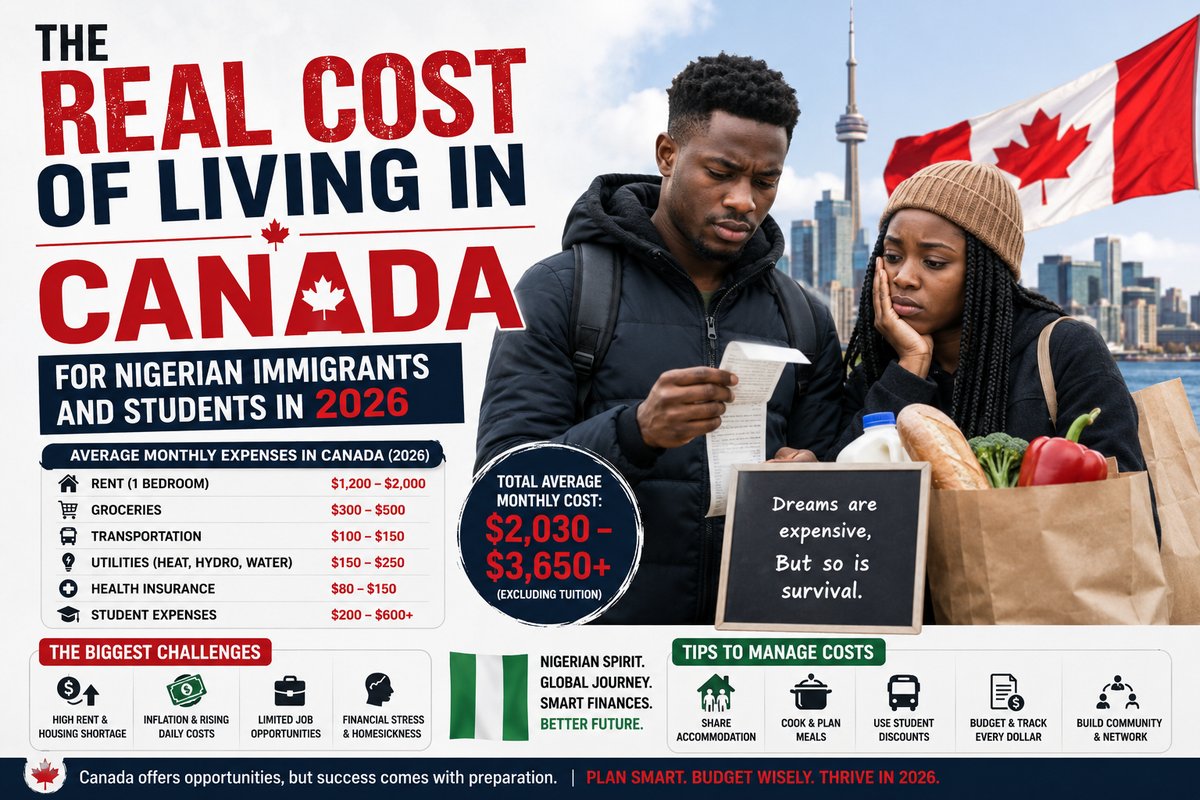
Among foreign countries, Canada consistently ranks among the top destinations for Nigerian immigrants and international students. With its world-class universities, pathways to permanent residency, multicultural cities, and relatively welcoming immigration policies, the appeal is undeniable. But there is a conversation that does not happen often enough before people board that flight like the honest, unvarnished truth about what it actually costs to live there.
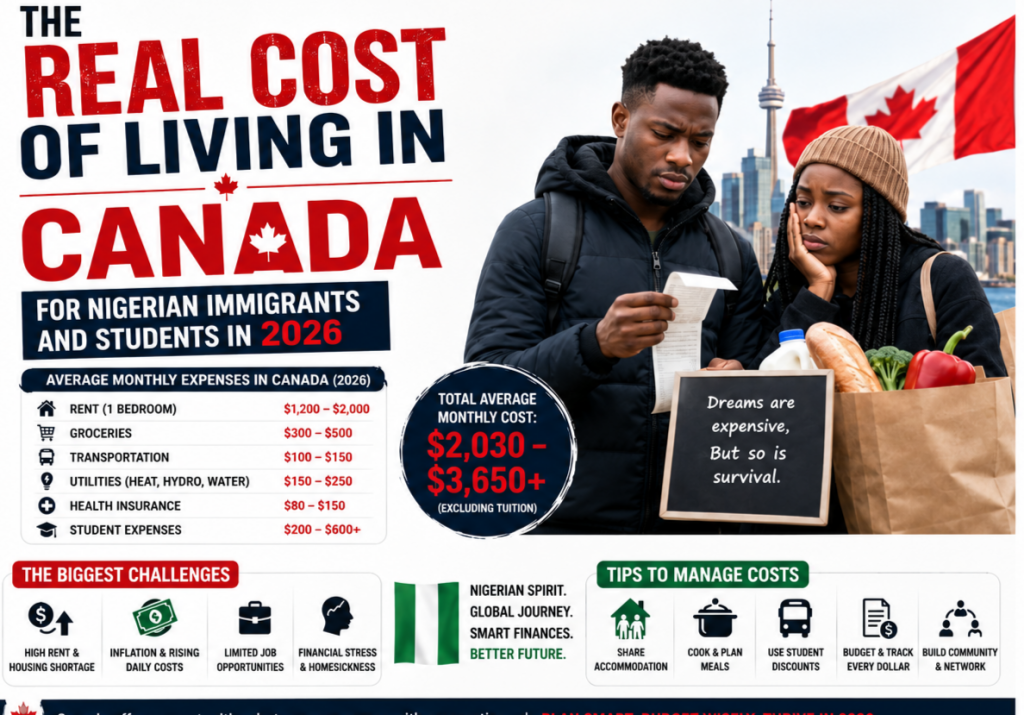
The Canadian cost of living has shifted significantly in recent years. Rent has surged in major cities, inflation pushed grocery prices higher through 2023 and 2024, and the Canadian dollar’s fluctuation against the naira has made everything feel even more expensive for those sending money home or converting savings. If you are a Nigerian planning to move to Canada in 2026 whether as a student, a skilled worker, a PR holder, or a newcomer, this guide gives you a realistic, city-by-city, category-by-category breakdown of what to expect.
No sugar-coating. Just numbers, context, and practical advice on budget cost of your stay in the North American country.
The Nigerian-Canada Financial Reality Check
Before diving into the figures, it is important to acknowledge a dynamic that shapes the financial experience of almost every Nigerian in Canada: the naira-to-Canadian dollar exchange rate. As of 2026, one Canadian dollar is worth approximately ₦1,100–₦1,300, although the rates fluctuate, therefore always verify current rates before making financial decisions.
This means that a monthly budget of CAD $1,500 represents roughly ₦1.65 – ₦1.95 million, a sum that explains both the aspiration and the financial pressure many Nigerians face abroad.
Meanwhile, understanding this isn’t meant to discourage anyone, instead it is meant to help you plan realistically so that Canada becomes the opportunity you came for, not a source of financial crisis.
Cost of Rent in Canada in 2026
Rent is the single largest expense for most people in Canada, and it varies dramatically by city.
The Canadian rental market remains tight, particularly in major urban centres like:
Toronto
Toronto is Canada’s most expensive rental market. As of 2026, expect to pay:
Shared room in a house or apartment: CAD $900–$1,300/month
Bachelor or studio apartment: CAD $1,600–$2,200/month
One-bedroom apartment: CAD $2,100–$2,800/month
For Nigerian students arriving at the University of Toronto, York University, or Ryerson; now Toronto Metropolitan University, living on campus where available is usually cheaper than the open market in the short term, but on-campus housing fills quickly and often requires early application.
Vancouver
Vancouver is comparable to Toronto in cost and in some areas exceeds it:
Shared room: CAD $1,000–$1,500/month
Studio apartment: CAD $1,800–$2,400/month
One-bedroom: CAD $2,300–$3,000/month
Ottawa and Calgary
Both cities offer meaningful relief from Toronto and Vancouver prices:
Shared room: CAD $700–$1,000/month
One-bedroom apartment: CAD $1,500–$2,000/month
Winnipeg, Halifax, and Edmonton
These cities represent some of the most affordable urban rental markets in Canada and are increasingly popular with Nigerian newcomers and international students:
Shared room: CAD $500–$800/month
One-bedroom apartment: CAD $1,100–$1,600/month
Key advice: Most Nigerian students and new immigrants share accommodation with flatmates to split costs. A three or four-person shared house significantly reduces per-person rent and is the norm among international student communities in every Canadian city.
Food and Grocery Costs
Canada’s grocery prices rose sharply between 2022 and 2024 and have only partially stabilised in 2025–2026. As a Nigerian cooking at home, you can eat well and affordably but it requires deliberate shopping.
Average monthly grocery spend:
Cooking at home (Nigerian and local food mix): CAD $250–$400/month
Eating out regularly: Add CAD $300–$600/month on top
Where to shop affordably:
No Frills, Food Basics, FreshCo, and ALDI are the most budget-friendly mainstream supermarkets in Canada, consistently cheaper than Loblaws or Metro.
African and Caribbean grocery stores is in Toronto, Ottawa, Calgary, Edmonton, and Vancouver, stock palm oil, crayfish, stockfish, yam flour, egusi, and other Nigerian recipes at reasonable prices.
At Asian supermarkets like T&T and Nations Fresh Foods there are affordable dried shrimp, fresh peppers, rice, and leafy greens that work well in Nigerian cooking.
A Nigerian student cooking at home meals like jollof rice, beans, stews, soups can comfortably feed themselves on CAD $250–$320/month if shopping strategically. This is one area where the diaspora cooking skills covered in posts like Healthy Nigerian Foods You Can Cook Abroad on a Student Budget genuinely pay off financially.
Transportation Costs
Canada is a large country and most cities are not particularly walkable outside their downtown cores. Transportation is a meaningful monthly expense.
Public transit monthly passes (2026 estimates):
Toronto (TTC): CAD $156/month
Vancouver (TransLink): CAD $109–$136/month (zone-dependent)
Ottawa (OC Transpo): CAD $125/month
Calgary (Calgary Transit): CAD $112/month
Winnipeg: CAD $100/month
Student discounts: Most Canadian universities offer discounted transit passes bundled into student fees, often reducing the monthly cost to CAD $50–$90. Always verify with your institution’s student services office.
Owning a car: Necessary in smaller cities and suburbs, but expensive. Factor in insurance (CAD $150–$300/month for a new driver, often higher for newcomers without a Canadian driving record), fuel, and maintenance. Most students and new immigrants in major cities rely on public transit and walking in their first year.
Healthcare Costs
Healthcare in Canada is publicly funded through provincial plans, but there are important nuances for newcomers.
Waiting periods: Most provinces impose a waiting period of up to three months before provincial health insurance e.g., OHIP in Ontario takes effect. During this period, you are responsible for your own medical costs. It is strongly advisable to purchase private temporary health insurance for the gap typically CAD $50–$150/month depending on the provider and coverage level.
International students: Many Canadian universities automatically enrol international students in a university health insurance plan, bundled into student fees. Usually this covers basic medical, dental, and prescriptions. Always check what your plan includes and opt out only if you have equivalent or better coverage elsewhere.
Once provincial coverage kicks in, most medically necessary services like GP visits, hospital care, specialist referrals are free at point of use.
Dental and vision care: These are not covered by provincial health plans for most adults. Budget CAD $100–$200 per dental visit if not covered by your student or employer plan. Many universities include basic dental coverage in student plans.
Tuition Fees for Nigerian Students in Canada
Canada’s tuition fees for international students are among the highest in the world and represent the largest single financial commitment for Nigerian students.
Average annual tuition for international students (2025–2026):
Undergraduate degree: CAD $25,000–$45,000/year (varies significantly by programme and university)
MBA and business programmes: CAD $40,000–$80,000/year
Graduate/Masters programmes: CAD $16,000–$35,000/year
College diploma programmes: CAD $12,000–$22,000/year
Important 2024–2026 context: The Canadian federal government introduced a cap on international student study permit approvals in early 2024 in response to housing and resource pressures. This has reduced the number of new international students entering Canada and increased competition for available spots. Nigerian students should apply well in advance and ensure they meet all financial proof requirements such as Immigration, Refugees and Citizenship Canada (IRCC) currently requires students to demonstrate funds of at least CAD $20,635 (beyond tuition) for living expenses for a single student.
Other Monthly Living Costs to Budget For
Beyond the big three of rent, food, and transport, here are the everyday expenses that catch many newcomers off guard:
Internet and phone:
Canada has notoriously expensive telecommunications. Expect to pay CAD $50–$80/month for a basic phone plan with data. Home internet costs CAD $60–$100/month. Look for student-specific plans from providers like Fido, Koodo, and Freedom Mobile for the best rates.
Utilities such as electricity, heating, water:
In shared accommodation, utilities are often included in rent. If not, budget an additional CAD $60–$150/month depending on the season. Canadian winters are brutal, so heating costs spike sharply from November through March.
Winter clothing:
This is a one-time but significant cost that many Nigerian newcomers underestimate. Proper winter gear; an insulated coat, thermal layers, winter boots, gloves, and hat can cost CAD $300–$600 if purchased new. Buy second-hand from Kijiji, Facebook Marketplace, or Value Village to dramatically reduce this cost.
Miscellaneous e.g toiletries, household items, laundry:
Budget approximately CAD $80–$120/month.
Realistic Monthly Budget Summary for a Nigerian in Canada in 2026
The table below provides a realistic monthly budget estimate for a single Nigerian student or newcomer in three different city types:
Expense
Expensive City (Toronto/Vancouver)
Mid-Range City (Ottawa/Calgary)
Affordable City (Winnipeg/Halifax)
Rent (shared)
CAD $1,000–$1,300
CAD $750–$1,000
CAD $550–$800
Groceries
CAD $280–$380
CAD $260–$360
CAD $240–$320
Transport
CAD $100–$156
CAD $100–$125
CAD $80–$100
Phone & Internet
CAD $100–$160
CAD $100–$150
CAD $90–$140
Miscellaneous
CAD $100–$150
CAD $90–$130
CAD $80–$120
Monthly Total
CAD $1,580–$2,146
CAD $1,300–$1,765
CAD $1,040–$1,480
Tuition fees are excluded from this table as they are paid separately, typically per semester.
Which Canadian City Is Most Affordable for Nigerians in 2026?
Based on the data above, Winnipeg, Halifax, and Edmonton offer the most accessible cost of living for Nigerian students and newcomers.
These cities have:
Lower rents than Toronto and Vancouver
Growing African and Nigerian communities
Reputable universities and colleges (University of Manitoba, Dalhousie University, University of Alberta)
Provincial immigration pathways (Manitoba PNP, Nova Scotia NSNP, Alberta AINP) that can support permanent residency
The trade-off is fewer direct job opportunities in some high-demand sectors compared to Toronto or Vancouver, and harsher winters. However, for Nigerians prioritising financial stability in their first years of immigration, these cities increasingly make more sense as entry points.
Can You Work While Studying or as a New Immigrant?
International students in Canada are permitted to work up to 24 hours per week during academic sessions and full-time during scheduled breaks under their study permit (rules introduced in 2024 — verify current regulations with IRCC as policies continue to evolve).
At Ontario’s minimum wage of CAD $17.20/hour (2026), 24 hours per week generates approximately CAD $1,650/month before tax — enough to meaningfully offset living costs. Many Nigerian students work in retail, hospitality, healthcare support, and warehousing alongside their studies.
Permanent residents and workers have no restrictions on employment and access the full Canadian job market.
Conclusion
Is Canada Worth the Cost in 2026?
Canada remains one of the most viable and rewarding immigration destinations for Nigerians but it demands honest financial preparation. The days of arriving with minimal savings and simply “figuring it out” have passed. Housing competition is fierce, living costs are high, and the pressure of exchange rate conversion makes every dollar feel heavier.
The Nigerians who thrive in Canada in 2026 are the ones who arrived informed and prepared: with enough savings to cover the three-month healthcare gap, with a realistic rental budget that factors in shared accommodation, with cooking skills that reduce the food bill, and with a clear plan for employment alongside study or settlement.
Canada is not cheap. But for those who plan well, the quality of life, the professional opportunities, and the pathway to permanent residency and citizenship make it worth every dollar.
